
How it works
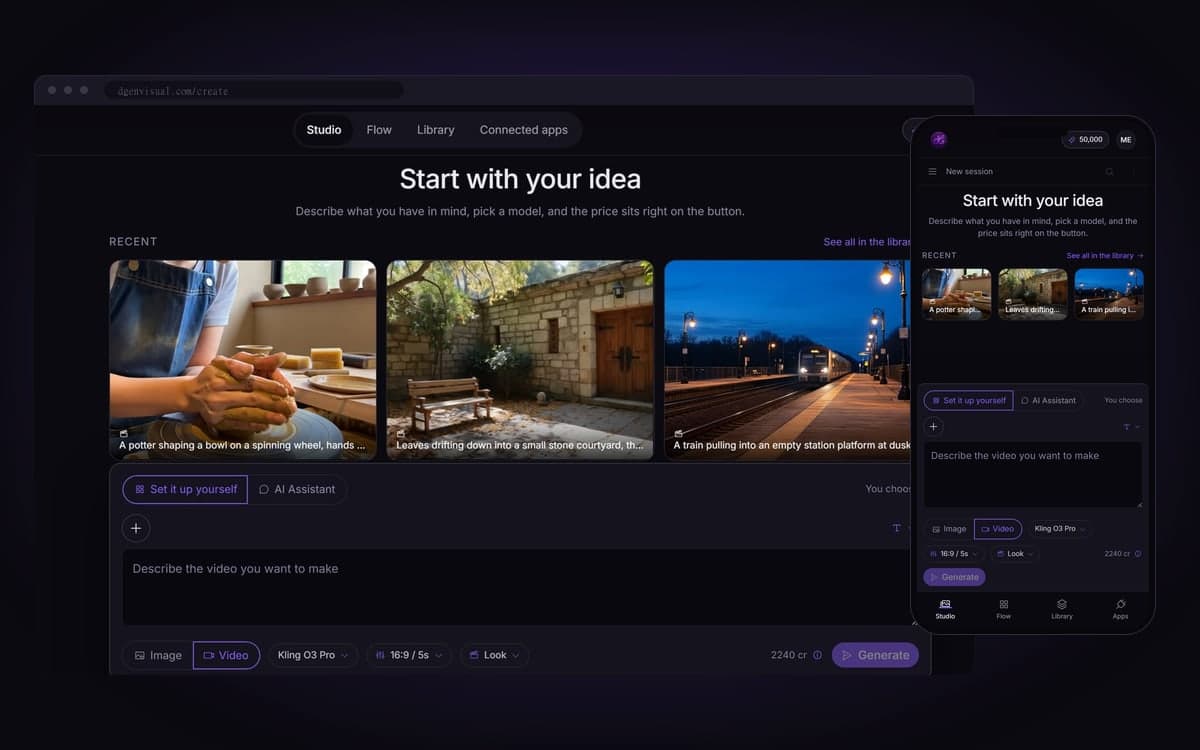
- 1Start from words or from an imageText-to-video needs nothing but a prompt. Image-to-video takes a photo or a generated still as its first frame, which is the surest way to control what the clip looks like.
- 2Set the length, the shape and the soundOnly the settings this model really has, read from its own schema. Sound is a choice up front and not something you add later, because a model that can make it charges differently for it.
- 3Longer than one clip? Write a scriptThese models make clips of a few seconds, so thirty seconds is a row of shots. Ask the assistant and it splits your idea into shots with one shared description, so the whole thing looks like one film.
- 4Check the stills before you pay for motionA storyboard makes one still per shot for roughly a tenth of the price. Approve them, and each approved still becomes the first frame of its clip, the strongest continuity there is.
What people make with it
Same script, another setting, face or mood. Run them side by side and put the winner in the campaign.
One idea, six clips, one shared look. The script tool writes the shots and keeps the character, wardrobe and light the same.
Several models make ambience, effects and lip-synced speech in the same pass. The studio shows which ones can.
Video-to-video models restyle a clip you already shot and keep the motion intact.
Attach the LoRA you trained and the video models that support it will use it.
Make your first clip
The studio opens in stages. We let people in in the order they signed up, and you start with 1,000 free credits.
Claim your spotGood to know
A clip takes minutes, not seconds. It finishes on its own and lands in your library when it is done.
Length, resolution and sound all move the price, and the number on the button already includes your choices.
34 video models start from text alone. Bring an image and the studio switches to the variant that uses it.
4 models build the clip between two images you choose. You decide where it starts and where it ends.
13 models work from reference images, so one character or product carries across a whole sequence.
If a run breaks on our side or at the provider, you get every credit back.
Questions
Can I make a video from just text, without an image?
Yes. 34 of the video models start from a prompt alone. If you do bring an image, the studio picks the variant of that model that uses it.
How long can a video be?
One run is a clip of a few seconds, usually five or ten, depending on the model. For anything longer you build a script: your idea split into shots that share one look.
Can the video have sound?
Yes, on the models that generate it: ambience, effects and lip-synced speech. The studio shows per model whether it can and what that does to the price.
What does a video cost?
It depends on the model, the length, the resolution and sound, and the exact amount is on the button before you press it. Packs start at €15 for 15,000 credits, about 93 images with Nano Banana or 10 short clips with Kling 2.5 Turbo. Credits never expire.
Can I check the shots before I pay for motion?
Yes. A storyboard makes one still per shot for roughly a tenth of the price of the clip. Every still you approve becomes the first frame of its clip.
Start making it yourself
The studio opens in stages. We let people in in the order they signed up, and you start with 1,000 free credits.
Get early access